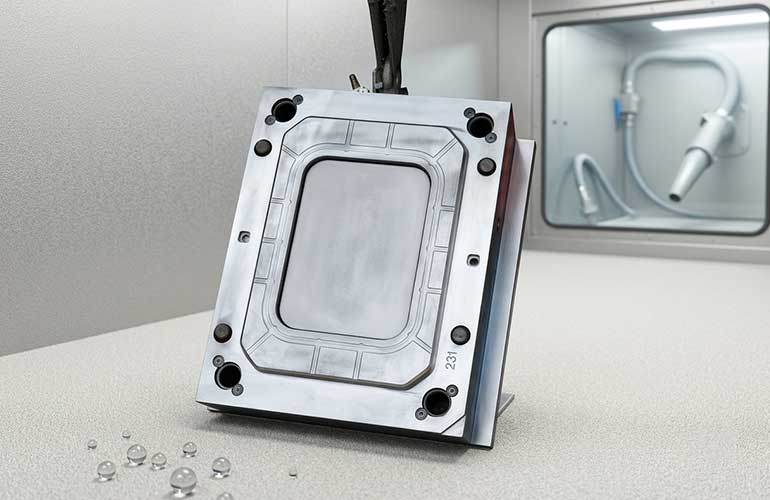
The Ultimate Guide to Plastic Die & Mould Sand Blasting
In the high-precision world of plastics manufacturing, the quality of your end product is entirely dictated by the quality of your mould. Over time, injection moulds and dies accumulate stubborn residue, gas burns, and material buildup that can compromise product quality and stall production lines.
Plastic Die & Mould Sand Blasting (often utilizing advanced micro-blasting techniques) is the industry-standard solution for maintaining, cleaning, and texturing critical tooling components without altering their strict dimensional tolerances.
What is Plastic Die & Mould Sand Blasting?
Plastic die and mould sand blasting is a specialized surface treatment process that uses compressed air to propel fine abrasive media against the surfaces of industrial moulds. Unlike aggressive structural blasting, mould blasting is a highly controlled, precision operation.
Depending on the desired outcome—whether it’s removing stubborn carbon deposits or creating a specific matte finish on a plastic part—technicians utilize specialized media such as glass beads, aluminum oxide, ceramic beads, or plastic media. This process restores the mould to peak condition, ensures flawless part release, and applies the exact surface topography required for the final plastic product.
Key Benefits of Mould & Die Sand Blasting
Investing in regular, professional sand blasting for your plastic injection moulds offers a distinct competitive advantage:
- Enhanced Surface Finish & Texturing: Achieve uniform matte, satin, or textured finishes directly on the mould, which translate perfectly onto the molded plastic parts.
- Prolonged Tooling Lifespan: Gentle, non-destructive cleaning removes corrosive gasses and PVC residue, preventing pitting and extending the working life of expensive dies.
- Improved Part Ejection: Eliminates micro-roughness and manufacturing blemishes that cause plastic parts to stick, reducing cycle times and scrap rates.
- Dimensional Integrity: Using precise, non-aggressive media ensures that critical sharp edges, parting lines, and tight tolerances of the mould are never compromised.
- Fast and Efficient Cleaning: Reaches deep into complex geometries, cooling channels, and intricate cavities that manual cleaning methods simply cannot touch.
Common Applications
Sand blasting is a versatile process utilized at various stages of a mould’s lifecycle:
- Pre-Treatment and Cleaning : Removing residual plastic, release agents, carbon buildup, and rust from the mould cavities without damaging the underlying steel or aluminum.
- Cosmetic Texturing : Creating specific aesthetic finishes (such as a subtle matte look on consumer electronics or anti-glare surfaces on automotive dashboards) directly via the mould surface.
- Flash and Burr Removal : Cleaning up the parting lines of the mould to ensure seamless closure, preventing flash defects on the final molded products.
- Coating Preparation : Prepping the mould surface by creating a uniform micro-anchor pattern, ensuring maximum adhesion before applying advanced coatings like Chrome, PVD, or Teflon.
Industries We Serve
Precision mould blasting is vital across sectors where aesthetic perfection and mechanical accuracy are non-negotiable:
Questions? You’re covered