Narayan Industries

Die & Mould Hard Chrome Plating

The Ultimate Guide to Plastic Die & Mould Hard Chrome Plating

In the high-precision world of plastic injection molding and die casting, the longevity and performance of your tooling directly impact your bottom line. Daily exposure to abrasive resins, corrosive gasses, and extreme cyclical pressures can rapidly degrade premium steel molds.

Hard chrome plating stands as the industry-standard solution to safeguard these critical assets, optimizing production efficiency and ensuring flawless product finishes.

What is Plastic Die & Mould Hard Chrome Plating?

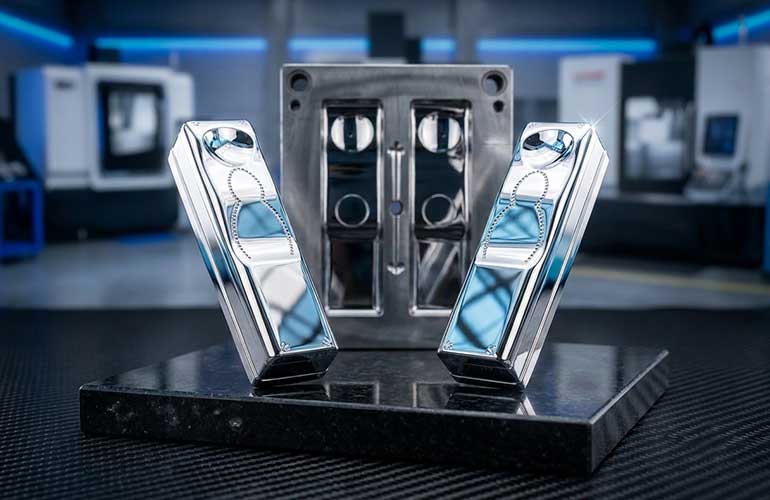
Plastic Die & Mould Hard Chrome Plating is an electroplating process where a precise, microscopic layer of chromium is engineered onto the working surfaces of manufacturing tools, cores, cavities, and inserts.

Unlike decorative chrome, industrial hard chrome is applied specifically for its exceptional hardness, low coefficient of friction, and wear resistance. This process fills microscopic imperfections in the base metal, creating an ultra-smooth, mirror-like barrier that protects the mold while enhancing its release characteristics.

Key Benefits of Hard Chrome Plating for Molds & Dies

Investing in professional hard chrome plating yields measurable returns across your manufacturing cycle:

  • Superior Wear and Abrasion Resistance: Hard chrome typically registers between 65 to 70 HRC (Rockwell C), drastically reducing wear caused by glass-filled or highly abrasive plastic resins.
  • Enhanced Corrosion and Chemical Protection: The molding of certain plastics (like PVC) releases corrosive byproduct gasses like hydrochloric acid. Hard chrome acts as a shield, preventing rust, pitting, and chemical attack on expensive tool steel.
  • Impeccable Surface Finishes: Whether your product requires a high-gloss optical finish or a specific textured matte look, hard chrome replicates and preserves the underlying mold texture perfectly.
  • Optimized Plastic Release (Anti-Sticking): Because chromium possesses a very low coefficient of friction, molded parts release effortlessly. This minimizes part dragging, reduces cycle times, and lowers the reliance on chemical mold release sprays.
  • Extended Tooling Lifespan & Strippability: Hard chrome can extend the operational life of a die by up to 4 to 10 times. Crucially, if the chrome layer eventually wears down, it can be chemically stripped and replated without damaging the original mold dimensions.

Common Applications

Hard chrome plating can be applied strategically to various components within a molding setup, including:

  • Injection Mold Cavities & Cores: To maintain tight tolerances and ensure flawless part cosmetics.
  • Extrusion Dies & Screws: Where continuous polymer flow demands maximum abrasion resistance.
  • Blow Molds: To prevent premature wear along pinch-off areas.
  • Slide Assemblies & Guide Pins: To reduce friction and prevent galling on moving mechanical mold components.
  • Compression & Transfer Molds: Ensuring durability under high temperature and tonnage.

Industries We Serve

High-quality hard chrome plating is essential across sectors where component precision and aesthetic perfection are non-negotiable:

Questions? You’re covered

01. Does hard chrome plating alter the critical dimensions of the mold?
Hard chrome can be applied in highly controlled, ultra-thin layers—typically ranging from 5 to 25 microns ($0.0002″ \text{ to } 0.001″$) depending on the application. Because it mimics the underlying geometry so precisely, it preserves critical tolerances. For ultra-precise applications, molds can be oversized slightly or post-polished to hit exact blueprints.
Yes. One of the greatest advantages of hard chrome is that it can be chemically stripped in a controlled environment without attacking the base tool steel. Once stripped, the mold can be repaired (via micro-welding if necessary), re-polished, and re-plated to look and perform like new.

While electroless nickel offers excellent, uniform coverage on complex internal geometries and solid corrosion resistance, hard chrome is significantly harder (68 HRC vs. ~50 HRC for as-plated nickel). Chrome is superior for high-wear environments involving abrasive materials like glass-filled nylon.

Absolutely. Hard chrome precisely replicates the texture of the substrate. If your mold has been sandblasted or chemically etched to achieve a specific matte texture, the chrome layer will bond to that texture without smoothing it out, while providing crucial wear protection.

Our Services

Download Brochures

We are always ready to help you and answer your questions